
The Postmodern Perfect
Schoenberg finds his Gil Evans

Sometimes a work, a project, a concept comes from so far out of left field that you have to catch yourself and say “what?!” It’s something that is so beyond the norm, so “out there”, indeed wacko, that you can’t at first decide if it’s brilliant, or foolhardy. Or perhaps just delusional. Anyway, that’s quite a wind-up for the ongoing series Schoenberg in Hi-Fi, the brainchild of the composer Aaron Wyanski. Those who know me from reading my criticism even a little will already know – spoiler alert – that I fall into the positive camp here. But having perhaps piqued your interest, I’ll give a bit of background.
Wyanski is a composer currently in what I would call his early mid-career, but he came to his practice a bit late. He’s a marvelous jazz pianist, and he has a deep and scholarly knowledge of the tradition. But from the very beginning, he also had a genuine love of the Second Viennese School. He was never put off by atonality and serialism. Indeed, I think he feels that those composers’ breakthroughs of style and technique were in fact an index of their freshness. (And realize we are talking about music from the first half of the 20th century, not so much the post-WWII generation that rationalized their discoveries into a much more constraining aesthetic and technical straitjacket.)
So quite naturally, the mixing of jazz and modernist composition is a natural intersection for him. This is not something unprecedented. Back in the mid 20th century, there was the school of “Third Stream”, where Gunther Schuller proselytized for a synthesis of jazz and classical practice. I think one of Milton Babbitt’s best pieces is All Set for jazz combo (as always he was a master of the bad pun). But Wyanski has taken this challenge and run with it in a different direction. He’s decided to create an alternative history working from a few salient facts. He calls this speculative musicology.
So there are three historical groundings for his project. The first is that fleeing the Nazis in the 1930s, Schoenberg came to America and ended up in California. He was hoping to break into the film industry composing soundtracks, but there was also a vital German emigré community in Los Angeles (Thomas Mann, Berthold Brecht, and Fritz Lang among others). Not surprisingly, the film composition career did not develop, but Schoenberg found a home in academia, starting at USC, and then moving after a year to UCLA, where he taught a renowned class in analysis and composition, and had a number of extremely talented and important students. The most unlikely but famous one is John Cage.
The second factor is that in this period there was emerging a new musical form that fit the mood of the era (I admit I’m stretching this a bit, as this emerges in the 1950s, just around the time that Schoenberg died. Cool jazz began to supplant the hot house frenzy of bebop, and in particular there emerged a knowing quasi-kitsch called “space age bachelor pad music”. It was pioneered by the transplanted Mexican composer/arranger Juan Esquivel, and its sound is exactly like its moniker: sci-fi, unrepentantly cheap, and sexy. But with great production values; and there’s an underlying current of Latin jazz.
The third and final influence is the emergence of a radically new technology for recorded music. This is High Fidelity, which morphed soon into stereo. Sounds were reproduced with far more accuracy and vividness, and found a new medium of distribution in the LP record, which gave almost an hour of music over its two sides. And the studio environment in which music was recorded (especially in the filmcentric world of LA) gave the potential for a product that was “larger than life“.
We already know that Schoenberg loved to play tennis in the balmy California climate. Wyanski goes one step further, and imagines that he found a way to create and rearrange his music in the idiomatic style of his new home. The result is, as they say, out of this world.
First of all, anyone who wants to get the full impact of this music should simply go to the composer’s SoundCloud page https://soundcloud.com/aaron-wyanski. You’ll find his arrangements of the Op. 11 and 19 piano pieces, and the Suite Op. 25. (You can also find his take on Op. 33 A/B on his Bandcamp page.) All of these are studio realizations. Wyanski painstakingly plays every note into a combination of Logic and ProTools. As a result, it has an utterly realistic, natural, and swinging character. The virtual ensembles range from small combos to big band. Every single note is from Schoenberg, and nothing is added, except – importantly – the rhythm track (as well as any doublings that enhance the orchestration). It’s amazing how having the drum set and other percussion instruments suddenly makes the music so “accessible”. The whole thing opens up. This goes a long way towards refuting the common saw that “atonal” music is inherently off-putting.
In a strange way, Wyanski’s project is something of a rescue mission. Schoenberg is not going away, and he remains an indelible challenge for everyone who maintains a critical stance toward art, believing that a challenging encounter is one route to greater understanding and personal growth. At the same time, though, it’s sad that so much of the music, especially the later serial works (which even I have problems with!) remain shunted into a dark alley of the repertoire.
It almost feels as if Schoenberg has found his true American collaborator to make this music “fit“ with his new home (hence the subtitle of this essay, if you didn’t already get it). Just two examples: the obsessively insistent minor third in the Op.19, No.1 becomes a sinister ostinato reminiscent of the Peter Gunn theme. And the fifth movement of the Suite, the Gigue, takes on the spiky ostinato angularity of a Thelonious Monk head.
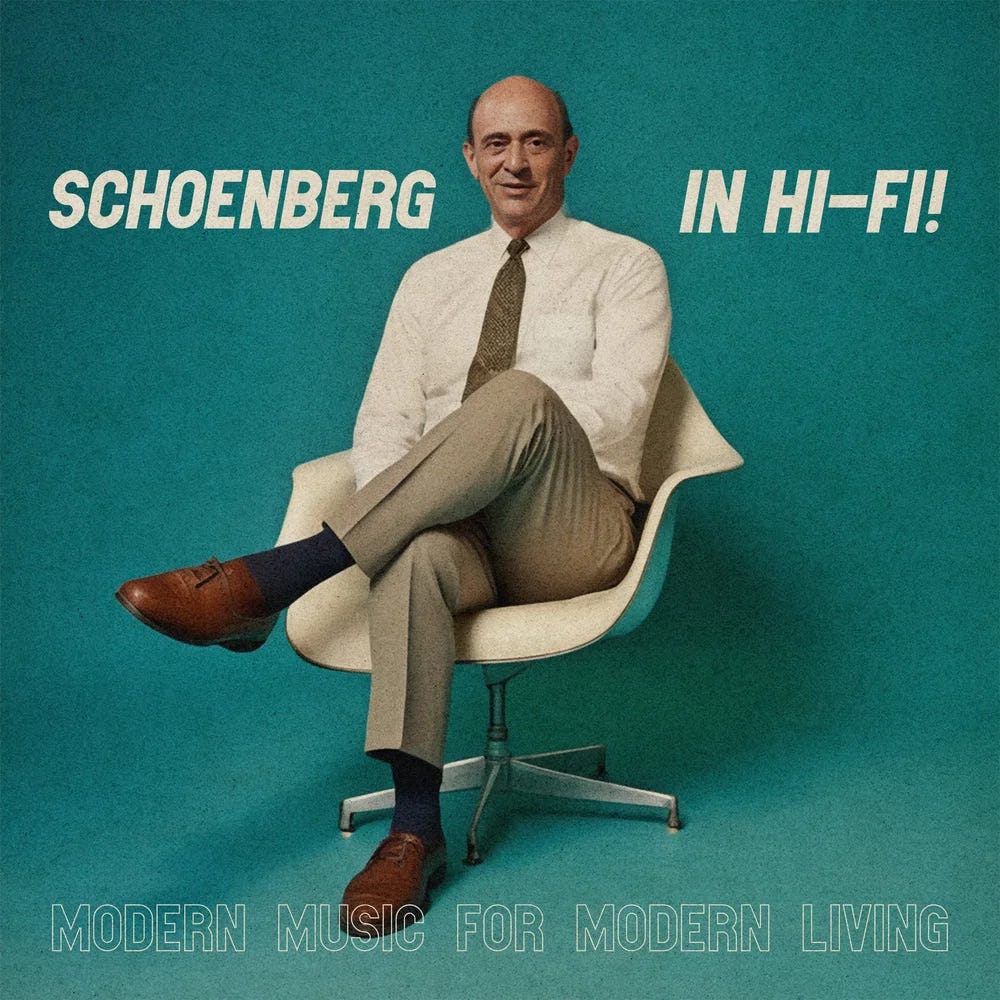
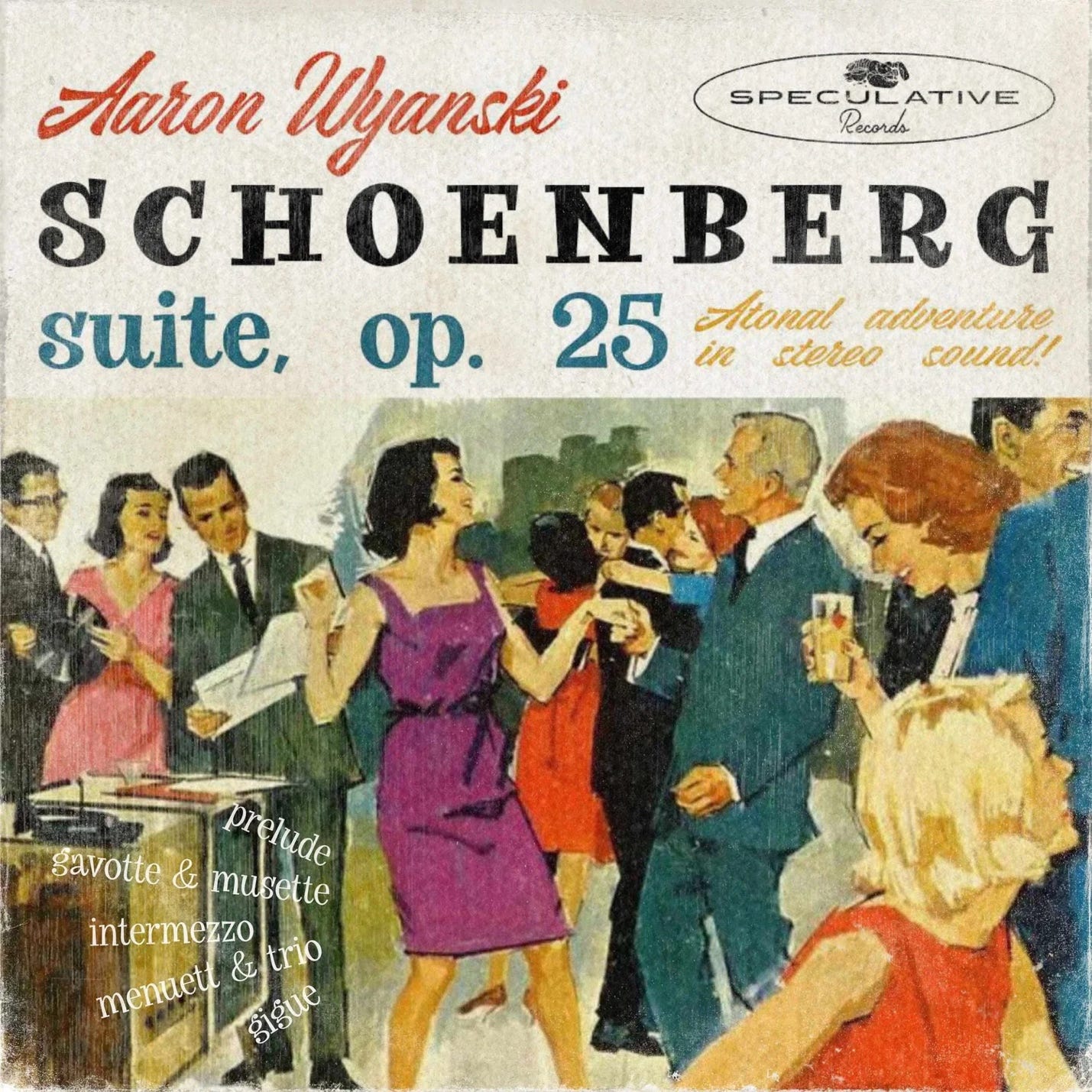
One also has to mention the album art, which the composer has created in the spirit of the times (see examples above): Schoenberg at ease in his Eames chair; the classic 50s party with drinks aplenty, dancing, and the sexual revolution just around the corner.
I know that Schoenberg’s son Lorenz has reached out to Wyanski to thank and congratulate him on this endeavor. I think it is a good sign of its seriousness, despite the lighthearted surface. Indeed, the whole thing makes me think about what “classical” music can do, now that we are deep into its postmodern phase. Perhaps postmodernism itself is wearing out. And perhaps one of the most fruitful things we could possibly do would be to take earlier work and rewrite it in our own voices, forgetting strict definitions of “originality”. After all, Stravinsky provided an almost perfect model early in the 20th century. It was called neoclassicism, and in other cases orchestration/arrangement (cf. Pulcinella and Le Baiser de la Fée; even Schoenberg hints at it in works like his Cello Concerto, after Monn).
But in fact, this isrecomposition. Or perhaps, as Wyanski posits, speculative musicology –the perfect postmodernism?
Love this. Wyanski is some kind of genius.