
The Space Poet
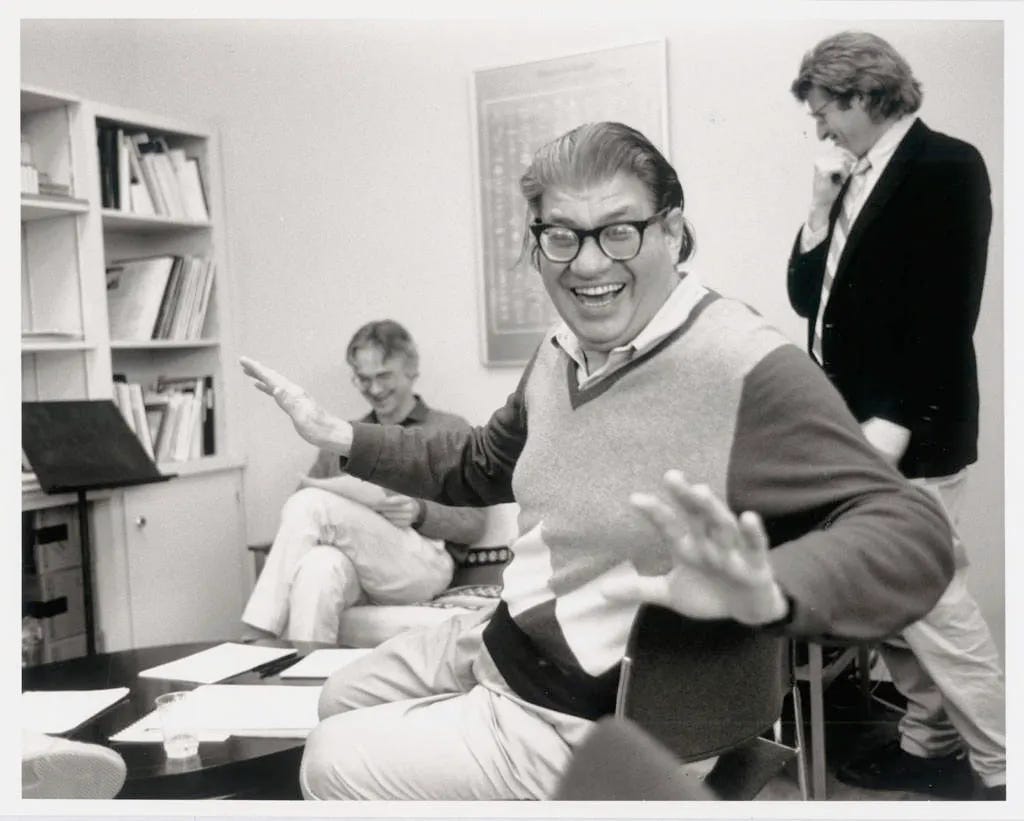
Morton Feldman at 100

The preceding post dealt with the erosions of time, memory, reputation… and the relentless winnowing thereof by history. In looking at some of the major American composers in the late 20th century, whose career and reputation were then going gangbusters, it’s sobering to see how less of an impact they now seem to have on the current musical culture and certainly on the estimation of the young.
But there’s a flipside to this coin, and it’s the composer who is today’s topic. He’s had perhaps the greatest “postmortem” career of any of his peers, with performance, recording, critical estimation and continuing discussion of his work. We celebrate his centennial this year. I’m talking about Morton Feldman.
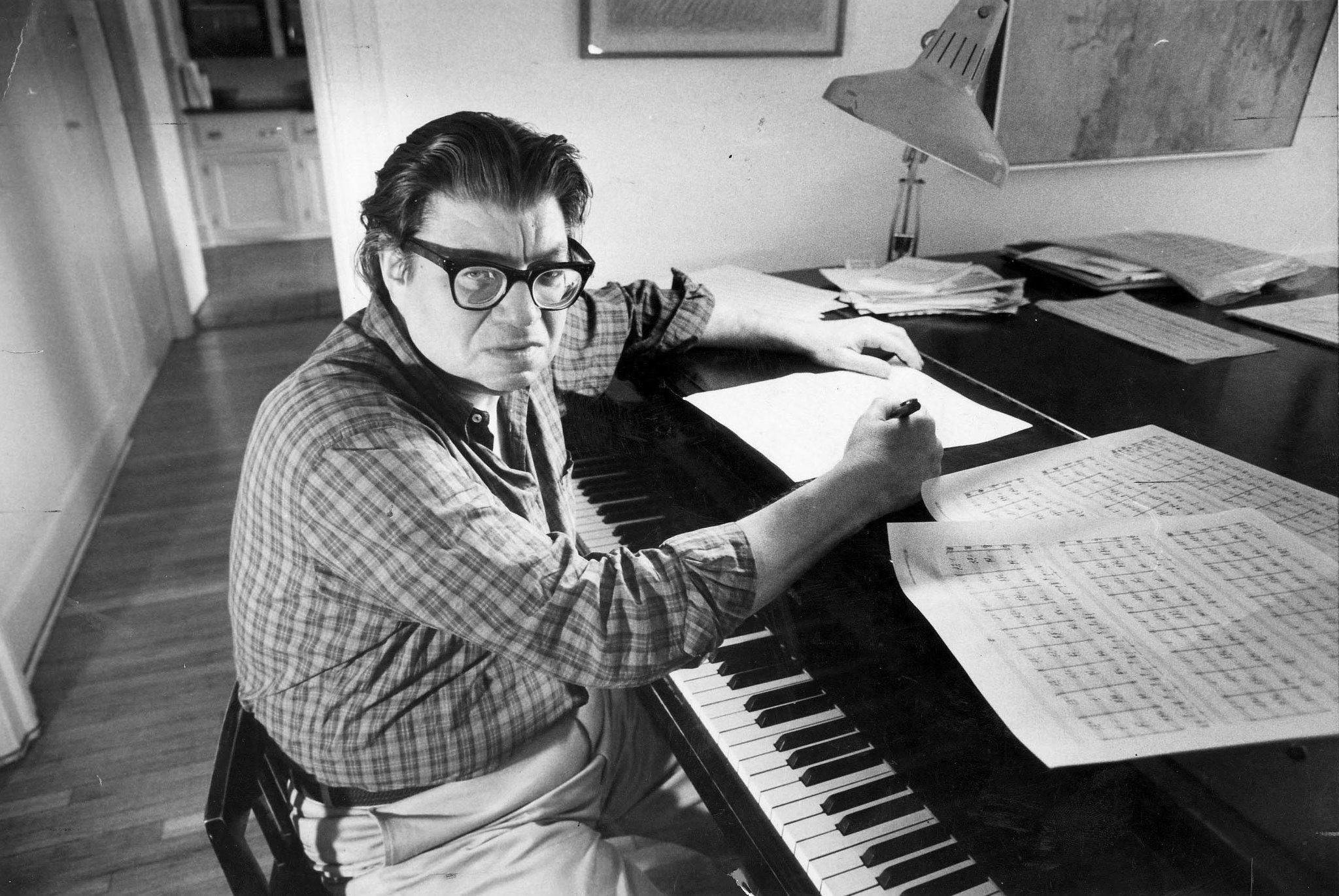
While he always had a much more visible presence abroad (especially in Europe), in the States Feldman was always more on the margins. At least some of the composers who made up the cohort of my teachers and mentors saw him as a fake. To them, he was someone who figured out how to write just a few notes and invest them with more meaning than they merited. The music was so soft, slow, spare. Its lack of any evident complexity made it supremely suspect. He was technically a dead end to avoid imitating.
And I will say that the surface aspects of Feldman‘s practice could make for a very easy template from which an impressionable young composer could crank out music with a similar affect. In fact, the same could be said for the early “classic” minimalist pieces of Reich, Riley, and Glass. But with time’s passage, a perspective grows on Feldman’s work that points out its richness, originality, and prescient take on so many aspects of 20th (and 21st) century practice—and yes, its genuine complexity. Let us count the ways.
First, though he will always be linked with the circle of younger composers around John Cage, Feldman simultaneously was an important influence on his mentor. To take just one example—looking at Cage’s late “number pieces”—their sustained tones, floating structure, and privilege of silence all feel indebted to Feldman. There’s a series of recorded late night New York radio broadcasts in the late 60s on WBAI where the two of them were given studio time to simply shoot the breeze. It’s very much a meeting of minds and of equals.
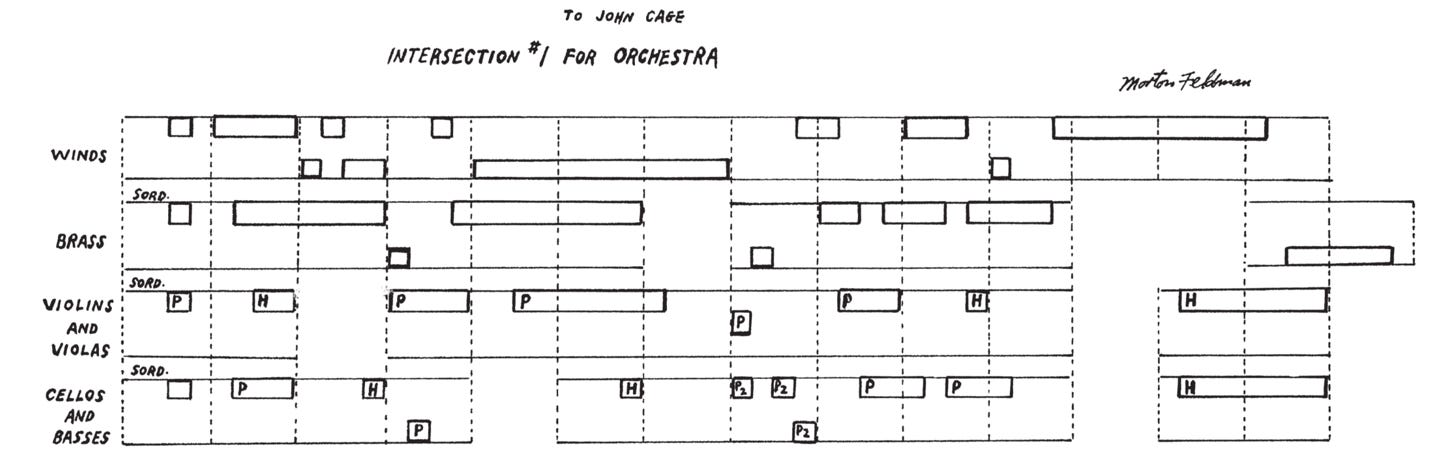
Feldman began as a composer very interested in indeterminacy. His graphic scores were designed to create pieces that were “fuzzy” in the degree of choice for various parameters. In fact, like so much of his music throughout his life, there are connections here to painterly techniques, and these scores look the part perhaps more than any in his oeuvre.
But he was also a composer gifted with an extraordinary ear, compelled to create a very personalized, but nonetheless real beauty. By the time we get to the 1970s, his need to create a genuine line – no matter how restrained and fragmented – and to explore a singular vision of harmony, asserted itself, and would only grow through throughout his remaining decades. To take a historical analogy, if Cage were Schoenberg, then Feldman was Berg.
When we begin to listen to the music free of preconceptions based on the aesthetic battles of decades past, it becomes much easier to appreciate its true nature and virtues. Feldman‘s practice exists at a remarkable sweet spot between a number of tendencies. Taking Cage’s cue, it foregrounds silence as an essential part of the musical discourse. It is repetitive in the nature of minimalism, even though more of a precursor. It is also extremely mutable in the spirit of high modernism. And in a prophetic mode, it expresses a restrained, but rich Neoromanticism. Somehow, these are all present, and I want to unpack this further.
The silence in Feldman‘s music is different from that of Cage, in that it is not an equal partner alternating with sound, but rather a complementary ambience that embraces the music. As one listens, and in particular because of the spare texture, the music gains a special aura from the empty space it exists within. And its often extremely low dynamic causes the listener to “lean in”, listening with more than usual attention. For me, this background silence evokes a great space in which the work unfolds. And indeed, in both volume, texture, and pacing, Feldman seems one of the greatest poets of musical space.
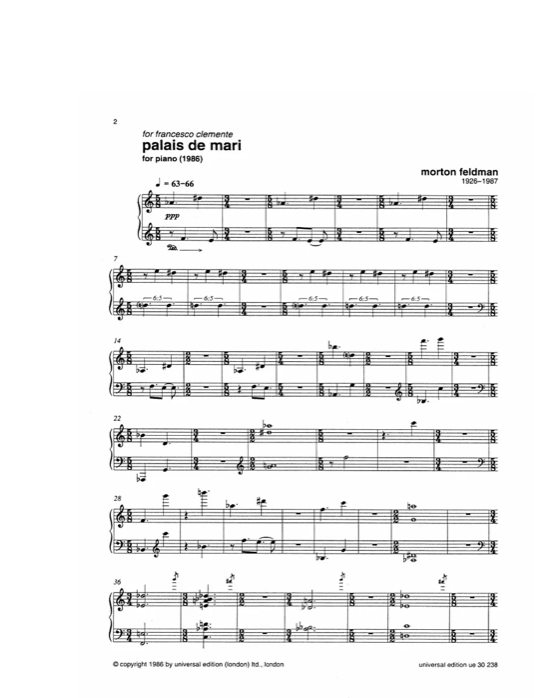
As for repetition, it’s important to realize that as soon as one looks at a score, it is nowhere as rote and invariant as one might think. There’s only one Feldman piano piece I’ve actually taken the time to learn, Palais de Mari. And I can tell you that, even though a motive has a recurrent template that may last for a while, almost every time it recurs there is some slight difference, especially of rhythmic duration. A note may be either shaved or added by a fraction of a beat. A note is suddenly dotted. Registrations of pitches in a chord change from one appearance to the next. All of this results in something that is familiar, predictable in its unfolding, and yet at the same time not. And this fascination with precise microvariation is part of what makes the music truly complex, and in fact an offshoot of high modernism. It reminds me of what performers say about Mozart – deceptively simple on the surface, but incredibly treacherous in that every note is exposed, and every mistake is evident.
It’s also important to remember Feldman’s deep engagement with the visual art of his time and peers. Second generation abstract-expressionist and conceptual artists became increasingly enamored of series of works, taking an initial form as a template, and then working almost infinite variations on it. When he found his voice, Mark Rothko (for whom Feldman was the estate executor) found infinite inspiration in the layering of usually no more than two squares of color upon one another. One senses the same with the mystical grid pastels of Agnes Martin. These paintings were not hard-edged, but then there were also similar more “tight” experiments by Frank Stella, and even the explicitly algorithmic works of Sol Lewitt. The list goes on. And let’s not forget Feldman‘s passionate interest in Middle Eastern carpets…
And now we reach the connection to the great tradition, in particular and less immediately evident, that of romanticism. It was around 1970 with the Viola In My Life series, that the composer made a return to traditional notation from his graphic practice. The result was music that had a newfound poignancy. There were real motives amidst the abstraction, even some with programmatic associations (the clearest is the cuckoo clock in Madame Press Died Last Week at 90, his brief tone poem tribute to his childhood piano teacher). Again these float in the space a bit like dangling objects in a mobile. They take on a meaning that feels private and personal, and remain mysterious even once those intimate thoughts enter public hearing.
Throughout, the duration of the pieces just continues to grow – and grow and grow. By the time we get to the six-hour Second String Quartet we are moving into Mahler/Bruckner territory—in fact far beyond. Feldman spoke about the difference between duration and scale, the latter taking on an almost geographic character. These works demand a different approach to the very act of listening. (And might I add that by the time we get here, the “not enough notes” critique doesn’t hold up. It took an enormous degree of commitment and concentration to write all of those notes down for these immense pieces, and it was all done well before any copy/paste function.)
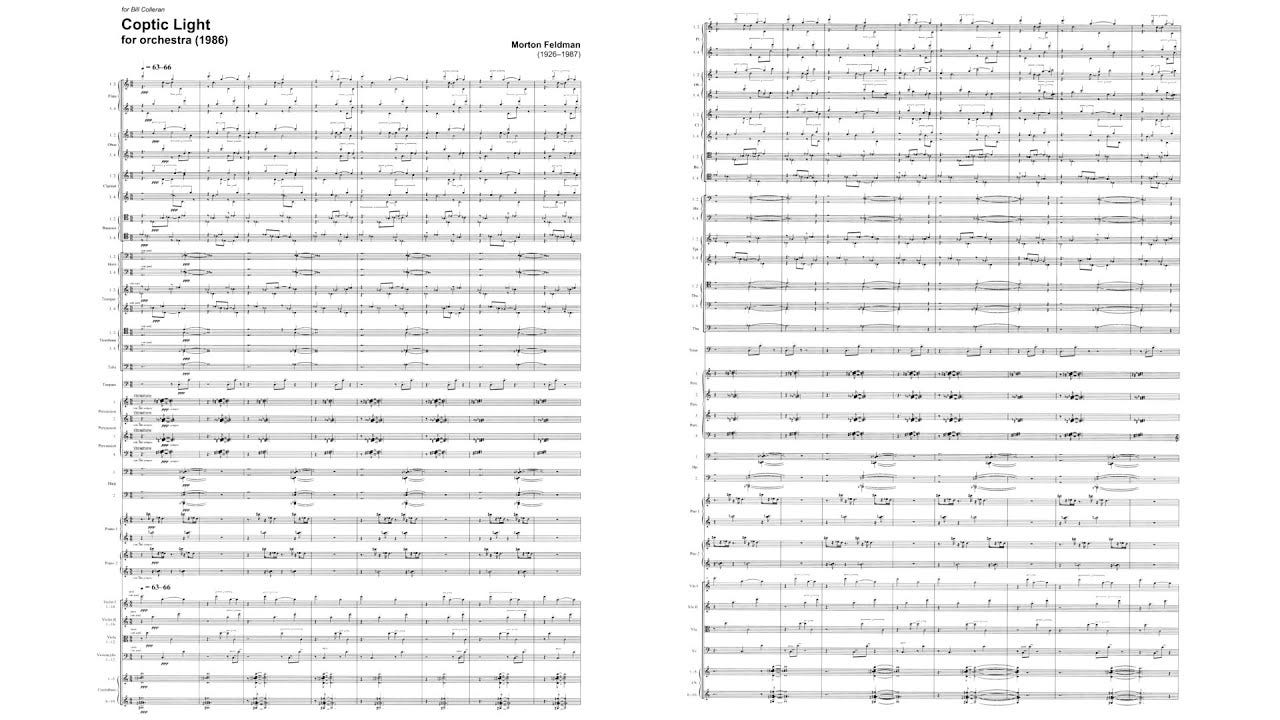
Finally, a word about orchestration, though really this is talking about Feldman’s approach to sound itself. When you listen to his orchestral pieces, the sheer expanse of the sound is remarkable. It seems as if that silence we mentioned before (which creates the aura), has now become activated into a truly sonic aura in its own right. The apogee of this is the late orchestral work Coptic Light (written 1986, the year before he died). Its continuous waves of sound create harmony unlike any I’ve ever heard. It’s not tonal, but it’s comprehensible. There’s a harmonic richness here that has almost no analogue in other western music. It’s also worth noting the way that Feldman uses percussion to enhance the aura. Whether it’s gongs or rippling arpeggios, one doesn’t hear punctuation so much as timbral extension coming from the section. The usual “raised surface” use of percussion is inverted – it creates a sort of concavity in which the body of the texture rests. [And incidentally, this is one of many works that give the lie to the myth that Feldman never wrote music with loud events!]
A word about harmony. Feldman’s music is not tonal. The pitch groups (once called simultaneities in the jargon) are largely atonal, often quite dissonant, without reference to any larger framework (I think!), and certainly not to scales or modes. In this sense, it’s part of the post-tonal world that dominated academia in the second half of the 20C. But the fact that these “aggregates” are repeated so often, causes them to take on a tonal function nonetheless. Here’s another one of those fruitful paradoxes with which his music abounds.
I met Feldman once, though only over a short extended period. Between graduate degrees, I attended June in Buffalo in 1978, when he still ran the show. It was two weeks of concerts, lectures and seminars; unlike now, young composers were only allowed to be auditors—one didn’t have performances of one’s work. But there was a single seminar where he looked over the students’ work and gave pronouncements. I found it rather disappointing; Feldman basically said we were all taking the wrong direction and should study his work more closely. At the time it felt a bit offhand and cruel. But he had almost a decade of extraordinary work ahead, and I think he could only give so much attention to work of those he felt were too far behind him. In retrospect, I forgive--it’s not even my place to do so. The example of his work is the greatest lesson now.
Perhaps this begins to suggest why Feldman is having such a successful aesthetic afterlife. He took an enormous gamble to write music that went against the grain of so many prevailing trends and tastes of his time, but it was based on his absolute conviction in the rightness of what he heard and imagined. And as I hope I’ve outlined, he was in fact a prophet of sorts for a host of new directions in music, something I believe he knew. It’s a great gift to composers now, and given at enough of a distance that we can all engage with him without fear of being overwhelmed. May we all listen deeply to see what may emerge.
Thank for this essay! Feldman is one of the few post-WWII to 1990s composers I was 'supposed' to like and study – likely because I'm a product of 2011-2025 musical academia when he was being re-evaluated – but in the last few years I've come back to him and emulated certain elements in my own musical explorations. I particularly loved
"The silence in Feldman‘s music is different from that of Cage, in that it is not an equal partner alternating with sound, but rather a complementary ambience that embraces the music. As one listens, and in particular because of the spare texture, the music gains a special aura from the empty space it exists within. And its often extremely low dynamic causes the listener to “lean in”, listening with more than usual attention. For me, this background silence evokes a great space in which the work unfolds."
I also like (and will use in the future, should I ever get to teach fromally) your phrase about his extremely specific, "precise microvariation," a perfect encapsulation. I hear in this the spirit of the 'minimal' in Minimalism (especially the visual aspect!) paired with Schoenberg's compositional values.